======================================
Thursday, February 11, 2010
Where I then make up for my lack of "Reviewyness"
======================================
Saturday, October 11, 2008
Yellow Flag by Robert Lipsyte
Kyle has grown up in a racing family starting with his Great Grandfather. He loved it as a kid, but at some point, after racing cars for several years, he decided he'd rather not do it anymore. It was a hard won battle and he got heavily involved playing trumpet in the band. Now he's 17 and in a jazz quintet that could be going places. He's sort of loving his life. Then his older brother has a bad wreck. Not only is that scary in its own right, but he's also got some intimidating and life changing decisions ahead of him. Does he drop everything to race for his brother? Does he refuse his family and stick to his guns? Kyle thought he had everything figured out, but as he's drawn back into his family's racing business the more he discovers he really hasn't got a grasp on anything.I think it's possible that Lipsyte is the only author that could have possibly gotten me to enjoy a book about car racing. He has such an incredible talent for describing action and raising the tension until you absolutely must know what happens next. The racing action was superb, as was the behind the scene details of what racing entails - the sponsors, the car maintenance, the different jobs people have to do to support the person driving the car. I also felt it was a realistic portrayal of the pressures a child would face when he is born into a family that has focused their entire beings on car racing.
My only real complaint was a character that was a friend of Kyle's that responds to everything with, "saw that movie..." and goes on to name a movie, name the actors, etc., in what one assumes is an attempt to relate to a situation. It completely irritated me.
Other Reviews:
Ms. Yingling Reads
Monday, August 25, 2008
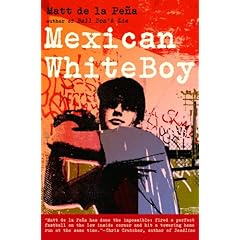
Mexican Whiteboy by Matt de la Pena
Danny is a quiet boy (as in almost mute) not because he can’t talk, but because he doesn’t want to. His father left and went back to Mexico a few years back and since then Danny has completely withdrawn into himself. He lives with his white mother and younger sister and attends an exclusive private school on a scholarship. When he’s at home he feels like he’s too brown, too Mexican to fit in and craves to be more involved with the Mexican side of his family. But then when he’s with his extended Mexican family he feels too white.Obviously, Danny has issues. He has convinced himself that if he writes long letters to his dad telling him how awesome his life is going (regardless of the fact it isn’t true) his dad will come back. Danny feels as though it was because he was too white, too boring, just not good enough that his dad left. He blames his mother while worshiping the father that left. The thing about Danny is that he doesn’t act out. Besides some self inflicted wounds, he holds the pain inside, he is quiet, the eternal observer, and so no one really notices that his spirit is sort of dying. The only time he comes alive is when he is playing baseball. Danny is good. Extremely good.
His inability to feel completely comfortable in either culture is completely believable. Danny doesn’t know Spanish, is practically the only brown kid at his school, can tell what people think of him when they see him. Too brown for the whites, too white for everyone else. He feels shame that he attends a private school and gets good grades, he longs to be tougher, more street smart like his cousins and can’t help but wonder if the fact that he isn’t tough is yet another reason his father left.
Then the opportunity to spend the summer with the Mexican side of his family appears. I really loved the people that Danny met. His extended family (especially his girl cousin closest in age), her friends, and especially Uno the thug who turns out to be so much more than that. It is Uno that really pushes Danny to become more than he is. More outspoken, more confident, and more willing to take risks. Together they hustle the neighborhood with Danny’s baseball skills. In return, Danny shows them by example that they could do more with their life than hanging around the neighborhood playing out the same tired out negative roles. De La Pena does this with subtlety and so the message never feels heavy handed.
There are some weaknesses to the book. Danny’s phone conversations with his mother lacked believability. Although there were reasons for her monologues and supposed lack of interest in Danny that were explained later in the book, it still seemed forced and not up to the level of dialog in the rest of the novel. And the fact that she called him “Danny boy.” Perhaps he was Irish on that side, but still the nickname was totally jarring, although I suppose teens not familiar with the popular Irish song probably wouldn’t be bothered at all. Uno’s reformed gangsta father also felt a bit off. He is a man who tends to monolog all day spreading his “wisdom” to his son. Uno thinks his dad is giving him “mad wisdom” if he could just understand him, but truthfully, I don’t think anyone could understand what his dad was saying –whether or not it was intentional I’m not sure.
The book ends with family secrets being revealed alongside an extremely disturbing violent encounter that has Danny reevaluating his thoughts about what exactly he wants his life and future to look like.
A fast read that will appeal to your reluctant readers.
Saturday, May 31, 2008
Another Kind of Cowboy by Susan Juby
Alex loves dressage. I mean really loves it. So much so that when he was a kid he leashed up his bike, aka Magnifico le Noir, pretended Magnifico was a horse, and drove around the driveway yelling out movements. His mom thinks horses are dirty and nasty, but his dad brings home a horse one day anyway (he won him in a poker game). Alex loves his horse, even if his dad forces him into western riding because dressage is too girly.Susan Juby's writing is understated and I think the book ends up all the funnier for it. She slips in these incredibly observant and witty comments that you start taking for granted. It is written in alternating perspectives. Alex (who is in third person) and Cleo (who is in first). It is interesting to see how the characters view each other, situations, and how they react. Alex is incredibly earnest, hardworking, and quiet. Cleo is a spoiled rich girl, somewhat delusional, and is outspoken.
The secondary characters are superb. Alex's younger twin sisters are into martial arts and have a running commentary where they imagine scenarios where they must come to the rescue. His aunt is a beautician who fails spectacularly at her cooking attempts. His dad is a drunk who lives in an RV in the front driveway and has a girlfriend who in a desperate attempt to hide her increasing baldness has died her hair bright orangey red.
Alex is a another kind of cowboy for two reasons. The first is because he prefers dressage, the second because he is gay. Its something he's always known - or at least suspected - because he's always felt different. The way in which his sexuality fits into the plot is deftly handled. Alex has sort of retreated into himself in an attempt to deal with a myriad of things, not least being gay. Instead of a big reveal where everything is resolved the author lets him grow and expand as a character very organically. Its a wonderful thing to read.
This one almost missed me. It was published in 2007. I highly recommend it.
Wednesday, April 9, 2008
Gym Candy by Carl Deuker
Mick lives for football. He always has - even as a little kid. Maybe he loved it at first because his father played in the NFL, maybe it was because it was something him and his dad played together, or maybe it was because he was so good at it. Regardless, at some point he started loving the game for the game. Only now that he's made the varsity team he's finding out that his natural talent might not be enough. At least not enough to be a starter - which he always has been until now. The temptation is deep. Should Mick work hard and just accept that he might not be good enough or will he succumb to the pressure and do whatever it takes to start?I'm not giving anything away by saying Mick gives into the pressure. He decides that he needs to be bigger, stronger, faster, and the only way to do that is to take steroids. At first he thinks it will only be until he makes the team, but then what happens if he goes off them? How does he maintain his gains?
I've read a lot of sports fiction the past couple of years (way more than this non-sports fan would ever have predicted she would have read if I'm going to be perfectly honest although I will say Ive enjoyed quite a few of them) and so I wasn't sure how this one would stack up. Usually steroids are in the book, but the main character abstains - its another character, usually a villain type that ends up taking steroids and then flaring out in a fit of roid rage to demonstrate "just say no" and you'll be fine. So I was surprised (pleasantly so) that this book had the main character give in to the pressure put on to him by his father and by himself. It blows my mind that steroids have invaded high school, however it is a fact and so I thought Mick's character was very true to life. He's not a bad kid, he's actually a pretty good one, but he's weak. He wants his dream so badly that he's willing to throw his morals and potentially his future out the window. He knows he's cheating and making poor choices, but it feels inevitable. And once he's started he finds out how hard it is to stop. Dueker doesn't demonize him, but he does use Mick's character to prove a point. Steroids will mess you up. If its not one way it'll be another, but don't fool yourself, they're not a quick easy fix for getting strong.
I liked Gym Candy quite a bit. It has lots of really good action on the field and deals with the emotional struggles of Mick with sensitivity and manages to avoid heavy handed moralizing. A good sports book, your football fans will enjoy it.
Saturday, December 15, 2007
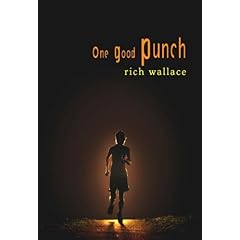
One Good Punch by Rich Wallace
Mike is a good kid. That’s what everyone would say. He keeps out of trouble and works hard at his job writing obituaries for the local paper. It’s not the most glamorous job, but he knows it gives him real world experience as a writer that will be invaluable later on. He also knows this is his year to prove himself on the track team – he’s been training all winter and they have a good chance of going to State. So everyone is surprised when a weekend drug sweep at the school turns up 4 joints in his locker. All of a sudden Mike’s got some tough choices ahead of him and his future depends on what he decides. One Good Punch is filled with life’s gray areas. Do you only tell part of the truth to get yourself out of trouble? Or is loyalty more important? Should you bank everything on what you thought was your future? Or are there alternate ways of getting there? Do you take your time to figure out your own mind on a subject? Or do you do what others want of you? The first person narration was very strong even though this is a very short novel, 114 pages to be exact. It’s what I would call a quiet novel even though it has the drug bust drama – it’s much more focused on how Mike determines his life’s direction than it is a problem novel per se. There will be setbacks, but Mike and