Wednesday, April 30, 2008

The Mysterious Benedict Society and the Perilous Journey by Trenton Lee Stewart

I love when sequels are just as good. As in its predecessor, The Mysterious Benedict Society consists of four orphans (now happily living with various loved ones via reunion or adoption!) solving puzzles through working together. When Mr. Benedict, namesake, gets kidnapped, the kids must band together again.

Putting aside quibbles and nervousness, each of the kids uses their strength to navigate around the world, sans adult supervision, and through the various puzzles and mysteries we loved so much in the first book. They feel guilty leaving their families worried, but do it for their beloved Mr. Benedict.

Through Portugal, Holland and Scotland, Reynie leads the group with his common sense and spot-on interpersonal intuition. Sticky gets to show off his skills at memorizing and foreign languages, sometimes to the annoyance of his mates. Kate's strengths are physical- she is fast, fearless, strong, and always has a bucket of supplies. Constance, age three, is astoundingly predictive... leaving us wondering whether or not she possesses psychic powers. I like that this book points out that there are lots of different ways to be smart, and that they're all important when you're facing amphibious forms of transportation, old Dutch journal articles, businessmen assassins (they use stapler removers and very sharp pencils as weapons!), and coded letters from a famed cryptologist.

Tuesday, April 29, 2008

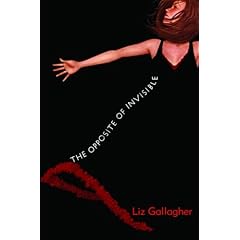
The Opposite of Invisible by Liz Gallagher

Alice has always sort of felt invisible. In the background. Not to her best friend Jewel, but to everyone else. She feels like she's sort of cocooned herself with Jewel at the expense of developing other friendships. So when Simon, a popular football player expresses interest in her (not to mention that he's been her secret crush) Alice feels that maybe she's not as invisible as she thought.

This book almost felt diary-like, it wasn't, but Alice is very much telling the story and it feels very up close and revealing. The book mainly deals with Alice's desire to become visible, to make other friends (especially some gals - Jewel is a dude), to reach out and try new things, to move beyond her cocoon with Jewel.

As Alice starts to put out feelers for other people her relationship with her Jewel changes especially when Alice starts dating someone. Someone not Jewel, which even though they weren't boyfriend-girlfriend, it sort of felt like they were a couple. So the dynamics shift and neither is sure where they stand anymore.

This was sort of a quiet novel with quite a bit of depth (and a beautiful cover...). Alice is a level headed and thoughtful narrator. A central theme in the book is that people aren't always what you think they are. Even in high school, well maybe especially in high school, people who you thought were one way often turn out to be another. We see this in her new friend Mandy - a cheerleader who happens to sign up for the same glass blowing class as Alice. And we also see this in the other central characters of Simon and Vanessa.

It was a sweet read that is clean enough to be in middle school libraries, but mature enough to appeal to high school students too.

Alive and Well in Prague, New York by Daphne Grab

Prague, New York is not Manhattan. It’s not even close. Their idea of fun is to go swimming in a pond. Seriously. Matisse Osgood, though, is a Manhattan girl, recently transplanted to Prague because her father (who has Parkinson’s, though the family prefers not to talk about it) needs a quieter life. Matisse is not happy. She misses independent film, good clothing stores, schools without cheerleaders, and all the rest, and she’s going to let everyone know it. She makes one friend in Prague, Violet, who is as unimpressed with the town as Matisse, though Violet has been there her whole life. Together, the two of them turn up their noses at everything and everyone in Prague while Matisse studiously avoids discussing anything that might turn personal. As debilitating diseases, do, though, her father’s Parkinson’s doesn’t magically disappear, and the family tension gets worse and worse. The queen bee cheerleader finds out that Mr. Osgood is sick, but misinterprets it and starts a rumor that he’s an addict, and Matisse realizes that this fiction is even more painful than anyone finding out the truth. But what can she do? If she does nothing, she’ll keep getting the looks that they’re giving her for having an addict father. If she tells the truth, it could turn into a big pity party. On top of all of that, some of these Prague-ites just won’t leave her alone. How can she get super-sweet Hal to quit butting in? How can she get Marco to stop showing up at her lunch table? Does she even want them to? And what’s going to happen with her dad?

In the end, I mostly liked this one. It took me about half the book to figure Matisse out, though; for the whole first half I half wanted to smack her for being so snotty about city vs. country life, and I couldn’t for the life of me figure out why she wouldn’t just tell people about her dad. I mean, it’s Parkinson’s! They’ve heard of it. They may not know the details, but it’s not like it’s something to be ashamed of. I finally started to get her, though, and recognize the giant walls she was building around herself. After that, it was easier to root for Matisse, and even like her. This was a quick read and will be fun for most (especially those with a bit of city-envy, I think), and will be comforting for any teen facing problems similar to Matisse’s.

Monday, April 28, 2008

Out of Line: Growing up Soviet by Tina Grimberg

I have a mild fascination with all things Eastern European. So when I heard about this memoir of a girl growing up in the Ukraine behind the "iron curtain" I knew I wanted to read it.

This was a very sweet compilation of stories about a childhood that although was very difficult in many respects was also filled with love and joy. Tina weaves stories together in an interesting way. She'll be telling one story, which to fully illustrate is intermeshed with another story, and when that is complete it is back to finish the original story. It probably sounds jumbled and hard to follow, but it isn't. It is actually lovely and serves to illustrate and fill out the narrative in a really interesting way.

There are stories of the long lines they had to stand in to receive food, how a connection with someone made all the difference between getting choice items to going home empty handed. A story of when her grandmother was sent to prison. Another that details the crush Tina had on Young Lenin, a statue that depicted Lenin as an eight year old boy with all the admiral communist qualities one could bestow on a statue. The stories are also interspersed with photos of the people she is discussing. Pictures of her parents, her sister, Young Lenin, her grandparents. All appear in the book. The last story deals with how they were able to emigrate from the Ukraine. Not an easy thing to do at that time.

This memoir could work with middle school students, but I think it is just as likely to appeal to high school students as well. It is short, but packs a wallop.

Friday, April 25, 2008

Wednesday, April 23, 2008

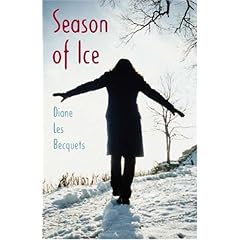
Season of Ice by Diane Les Becquets

Genesis remembers everything about that day. Everything is clear. What she wishes she remembered is saying that she loved her dad before he walked out the door. She wishes she had even just said goodbye. Instead she was so focused on beginning work on her car she let him walk out the door without saying anything. Then he never came back and her life changed forever.

Genesis and her family life in Maine on a large lake. Storms rise up quickly, people get lost in the woods, it isn't uncommon. However she never thought her father would be one of those people. She never thought he'd take the boat out on the lake and never come back. She never thought that they'd have to call off the search for his body because conditions are too bad. She never thought she'd start to second guess the character of her dad and whether or not he actually died that day.

While this isn't a mystery or a thriller there are definitely elements of those in this book. It is written with tension and feels a bit noir. The mystery elements drew me into the story. The author reveals things slowly, a comment here, a thought there, until you are sure the story is building to a certain point (which it may or may not do. It definitely wasn't a cliched ending). Add that to the cruel winter conditions that pepper the story and you have a good idea of the tone of the book. There were also some neat surprises. Genesis races cars on the ice and she's pretty good. I thought that was sort of cool parallel to life since that woman, Danica Patrick, just won some major car race.

She also added an author note explaining how she developed the idea for the novel. It was fascinating. I wish more authors did the same.

Monday, April 21, 2008

Paper Towns by John Green


I just finished reading the ARC of Paper Towns, and it was damn near perfect. I want to be a little bit jealous of John Green’s ridiculous amount of talent, but… I just can’t.

Since the book doesn’t come out for, like, six more months (I love my job!), I don’t want to tell too much of the story, but here’s a little bit: It starts out with Quentin Jacobsen, introducing the other major character, Margo Roth Spiegelman, his neighbor since they were toddlers, by telling about something that happened to them in elementary school. They’re now three weeks from graduation, and one night she appears at his window to take him out for a night of pranks/excitement/vandalism. He has the best night of his life and thinks it is going to be totally life-changing. Then she disappears. Like, completely. So the rest of the book is looking for this mysterious girl and piecing together the clues. I wouldn’t have thought of it as a mystery, exactly, though I see that it has “Mystery and Detective Stories” listed in the CIP information, and it’s true – there’s a whole lot of detective work. But, it’s not like a Sherlock Holmes mystery or anything, it’s much more internal: Quentin figuring out this girl, himself, and the way we are all connected.

Things that were awesome about Paper Towns:

Thing 1: It was structured in a really interesting way. I can’t say more without giving too much away. It didn’t seem to follow a traditional plot mountain, though, and it totally worked. (Did you all have to diagram stories with those plot peaks in middle school?) I fear that I was kind of useless while I was reading it, because I kept getting really involved in it and realizing that I’d just lost 30 minutes because there were so many “hangon,thisisareallyexcitingpart” parts.

Thing 2: Such great characters. On one hand, they’re very real teenage guys. They talk like teenage guys, they make jokes like teenage guys, they talk about stuff teenage guys talk about. On the other hand, they’re super smart teenage guys, with brilliant interior dialog, and it was so cool to watch Quentin fitting stuff together and thinking about life in the terms that I fear we lose as we get older.

Thing 3: Like with John Green’s other two books, there are all kinds of great, smart references. Song of Myself plays a big part in the story; Sylvia Plath, T.S. Eliot, Emily Dickinson, Woody Guthrie (yay!), and Moby Dick also all make appearances. There’s so much other stuff, too, and it’s amazing to me, here and in the other books, how much stuff he can pack into one book without it ever feeling confusing or cluttered.

Other, smaller stuff: I went to a panel at TLA where one of the things that was mentioned was the lack of parents in YA fiction. The answer was mainly that to have the teenage main character take off on his/her own adventure, you had to get the parents out of the way. It makes sense, but it also made me notice how present the parents were in this one. They weren’t intrusive, but it made for a realistic story about a high school student. And, mostly, it doesn’t matter, but I noticed, since I’d been thinking about it recently.

It was really interesting reading this book after having watched a good part of John Green’s life last year on Brotherhood 2.0. It was kind of interesting to see things pop up in the book and wonder if they were a nod to things discussed there, or to recognize things that there were B2.0 videos about that I now realize were research, like urban exploration. It seems like it should have been distracting, but it wasn’t at all. I really liked it.

Anyway, I love, love, loved it. Can’t wait to hear what others thought. In the meantime, I think I’ll go read Leaves of Grass.


A note on the two covers: when I first heard about the two covers, I thought, "Cool. I like it when books do that." When I heard that it was to illustrate the different ways this girl is perceived I thought it was a little... something. Overly dramatic? Something. But now, I love the cover. I'm still not nuts about the photos, but it really, really works with the book. Also, I was very impressed that (at least on the advanced reader copy), the letters are raised on the yellow, sunny version, and indented (depressed?) on the blue, sadder version. I'm impressed they made the effort. It's pretty cool. For the record, when I go to buy my real copy, I'm going to choose blue. Ooh, I wonder which color the library will get?! One or the other? An even mix?

Sunday, April 13, 2008

Billie Standish Was Here by Nancy Crocker

Billie is an eleven year old girl . Her parents are distant and cold, when they acknowledge her it is usually to find fault. She's got no friends, no one really to speak of. Until the day she wakes up and the entire town is gone...literally. Everyone packed up and left. It turns out the levee might break and her parents and one other woman are the only people who decided to stay and see it out. Billie is befriended by Miss Lydia, the elderly lady who has also decided to stay. This is a life changing event, a friendship that will alter Billie's life forever, for both good and bad.

The good is that Miss Lydia is a spitfire and is able to slowly show Billie that she's a worthy human being. The bad is that their friendship brings Billie to the attention of Miss Lydia's no good adult son who brutally rapes her. From other reviews I knew that this was a pivotal event in the book. And it is for this reason that I didn't pick up the book until I had to (it is nominated for the TAYSHAS Award 2009-2010) because frankly a story where a major plot point is the rape of an eleven year old girl seemed like a major downer to me and frankly no fun at all to read about. Its proof of how good the writing is that the book is so much more than this.

The writing is exemplary, I particularly loved the description:
"That day every house I passed looked to be abandoned. Dingy little boxes, most of them needing fresh white paint..an occasional outburst of aluminum siding in some color that would startle God."
The writing really spoke to me. The character development was also superb. We see Billie develop from excelling at invisibility to survive her difficult childhood to grow into a strong, intelligent woman. Miss Lydia is an amazing mentor, one whom occasionally seems a bit too good to be true, but nevertheless won my heart from the start and cemented my adoration when she solves the problem of her miscreant son. Billie Standish deals with weighty issues of abuse, survival, healing, and the difference friendship can make. It is a beautiful novel that will surprise you.

Friday, April 11, 2008

Let's Go Back to Sweet Valley, Shall We?

Back by popular demand, your friendly Sweet Valley High correspondent, with the dish on Secrets, the second book in the updated Sweet Valley series.

Here's the plot: To win the homecoming queen crown, Jessica will do anything to discredit Enid Rollins's reputation, and there's an ugly rumor about the star football player and the French teacher. Who wins? Who cares. Is there something between Ken and Ms. Dalton? Who cares. I know you'd rather hear about all the trendy crap they have.

Clothes:

  • Hawaiian-print Roxy dress worn by Jessica
  • Ralph Lauren sweater and distressed jeans worn by Bruce
  • Juicy Couture sweat suit worn by Enid
  • Roberto Cavalli referenced by Lila
  • Platform sandals worn by Lila
  • Black wrap dress worn by Jessica

I realize that the sandals and the wrap dress have no designer name attached to them, but Lila and Jessica wore them, and clearly they would never, ever, ever wear something that wasn't fabulously trendy.

Accessories:

  • Messenger bags carried by Jessica and Enid
  • Tan obtain in Cabo by Lila
  • Martinis inhaled by Lila and the others at the martini tasting party
  • Ronnie Edwards as worn on Jessica's arm at the homecoming dance

I find it amusing that Jessica finds Enid dull and annoying and clearly out of fashion, but they both carry messenger bags. Maybe Enid's has Dora the Explorer on it and it just got left out of the description...

Technology:

  • Email sent between Enid and George and subsequently forwarded to Ronnie by Jessica
  • Email sent to the Oracle staff to complain about the rumored relationship between Ken and Ms. Dalton
  • Photoshop software used to create incriminating photo of Ken and Ms. Dalton
  • iPod used by Olivia Davidson while working on the Oracle web site
  • Video yearbook ostensibly filmed in part at the dance
  • Cell phones carried by, well, everyone

You will note that Olivia has maintained her offbeat reputation in the new version and listens to crunchy folk music. Whew. I know I was worried.

Trendy Pop Culture:

  • "He's totally crushing" catchphrase said by Elizabeth to Enid about George
  • Reference to Heroes by Winston in French class
  • Cadillac XLR Roadster still driven by Bruce
  • Chocolate allergies suffered by Lila
  • Maxim magazine mentioned at least twice, once by Elizabeth
  • Prince William as an excellent crush
  • Jake Gyllenhaal as another crush
  • Martini tasting party hosted by Lila
  • Abercombie model looks sported by George
  • Evil carbs as avoided by Jessica and anyone else concerned with the perfect size 4

I rolled my eyes so far back in my head about the "he's totally crushing" remark that I'm still trying to get them back in the right place. And I'm still shocked that the Porsche is no longer considered a cool car. I guess I'm old.

Still, I can't wait until the third book, Playing with Fire, is released. There's lots of potential for fun and trendy items in that one, too.

Thursday, April 10, 2008

Hush: An Irish Princess' Tale by Donna Jo Napoli


I love fairy tales and legends. And I love modern adaptations of them. Especially those by Donna Jo Napoli. So, I was understandably excited when Hush showed up.

Set in Ireland, Scandinavia, and Russia in the early 900s, Hush is an adaptation of an Icelandic tale about a slave girl who is brought to Iceland by one of the tribal lords. The mystery of Melkorka is that she doesn't speak for over two years, and so is assumed to be mute.

Napoli's Melkorka is an Irish princess who must hide with her sister while her father avenges the mutilation of her brother at the hands of Norse visitors to Dublin, which at this time was a Norse settlement. Her father has agreed to give Melkorka to one of the Vikings as a wife, along with 12 "beautiful young maidens" to be enjoyed by his vassals. However, these "maidens" are actually Irish warriors who plan to attack once the Norsemen are drunk.

This is all just background. We never discover if this deception works, since the real action of the story follows Melkorka and her eight-year-old sister, Brigid, as they travel to a nearby ringfort disguised as boys. Along the way, they are captured by Russian slave traders and begin an agonizing journey from the land they love to the colds of Russia and Scadinavia. Brigid escapes (hopefully), but Melkorka must use silence and the head slavetrader's belief in magic to protect herself and the rest of the prisoners. Eventually, she is sold and travels to Iceland, the concubine of a Norse lord.

What makes this story so interesting is the focus on what Melkorka is thinking, since after Chapter 7 she does not speak one word. Her thoughts, emotions, and the struggle to retain her silence, no matter what, move the story. It is also intriguing to move through her world and discover the prejudices, misconceptions, and conflicts of the time period. When the story begins, Melkorka can only see the Norse as "heathens" and "crazy Vikings" bent on rape and pillage. By the end of the book, they are the only people she knows, some having become quite precious to her.

It is also a story of slavery--slavery in its earliest forms, without the issues of skin color. For all of the slaves in this book are white Europeans. But not all are the same--they differ in culture, religion, language--things that can be just as divisive, if not more, than race. Melkorka transforms from a spoiled, privileged princess into a ragged slave into a strange, witch (but still a slave) and finally becomes a treasured concubine, more like family than slave to her master. But she is not free. And the book does not wrap up with the curt happy ending. Napoli stays true to the original tale.

The thing to most recommend this book to teens is that whoever she is at various times in the story, Melkorka is always a teenage girl. She has the same emotional issues, the same hang ups as any modern teenager. And she faces prejudice and abuse as many modern teens do as well. No matter the time period, she is a remarkably strong young woman.